
Foreigners and Citizenship Law
Legal Status of Russian Citizens in Turkiye in 2026: Visa, Residence, Real Property, Citizenship and Deportation
In this article 17 headings
- At a glance: subject, rule, legal basis
- Russian citizens in Turkiye in numbers
- 1. Entry to Turkiye: 60-day visa exemption
- 2. Residence permit: the most common paths for Russian citizens
- 3. Real property acquisition: the nationality purchasing the most housing
- 4. Turkish citizenship and the obligation to notify Russia
- 5. Work permit, company and tax
- 6. Marriage, divorce and registration of decisions issued in Russia
- 7. Russian documents: apostille is sufficient
- 8. International protection and deportation
- 9. Custody and criminal proceedings
- 10. The 7 most common mistakes made by Russian citizens
- 11. Frequently asked questions
- Sources
- Conclusion
- Author Information
- Communication and Legal Information

Publication: · Last update:
This content is for general information purposes; it does not constitute legal advice for your specific case.
Legal status of citizens of the Russian Federation in Turkiye; requires an evaluation of the 60-day visa exemption, residence permit, real property acquisition, Turkish citizenship, registration of divorce decisions issued in Russia, and deportation rules together. This guide explains the rules applicable to Russian citizens as of 2026 in light of current legislation, official institution data and high court decisions. For other topics regarding immigration law immigration law service page you can reach out.
Short answer: Russian citizens holding ordinary passports for travel to Turkiye for tourism and business meetings visa-free for up to 60 days may enter; the 90-day period applicable to many countries does not apply to Russian citizens. For longer stays, it is necessary to apply for a residence permit before the period expires. Since Russia is a party to the Apostille Convention, Russian documents with an apostille can be used. Divorces performed at the civil registry office (ZAGS) in Russia can be registered in the population registry in Turkiye without filing a lawsuit, provided the conditions are met. The litigation period against a deportation decision for 7 days.
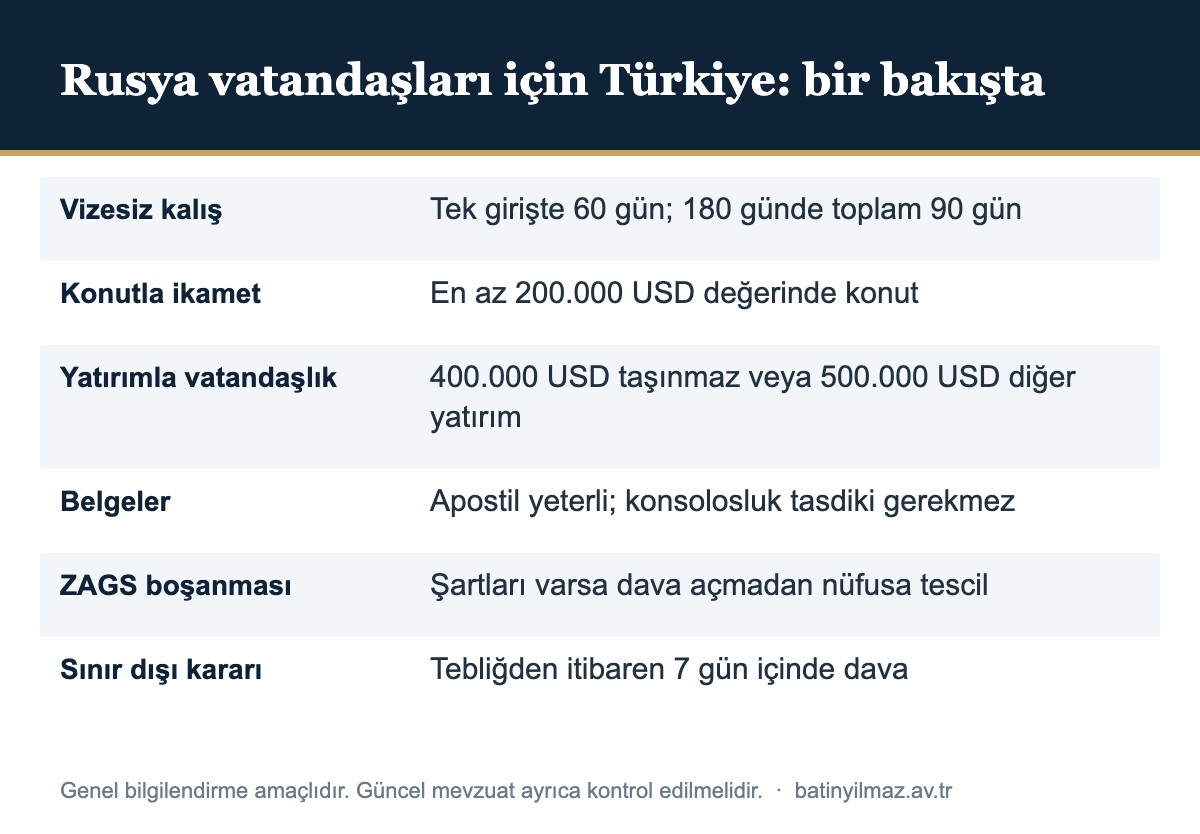
At a glance: subject, rule, legal basis
Scroll sideways for the entire table
| Subject | Rule for a Russian citizen | Legal Basis |
|---|---|---|
| Introduction | Visa exemption for up to 60 days with an ordinary passport for tourism and business meetings; 90-day total limit in the last 180 days | Ministry of Foreign Affairs visa regime |
| Service and diplomatic passport | Service passport: 30 days, provided that it does not exceed 90 days in 180 days. Diplomatic passport: 90 days | Ministry of Foreign Affairs visa regime |
| Residence permit | Short-term permit for a maximum of 2 years each time; USD 200,000 threshold for residence through housing | Article 31 of Law No. 6458; e-Ikamet document list |
| Residence by investment | 3-year residence permit for an investment of USD 150,000, 5-year residence permit for an investment of USD 200,000 | Article 31/1-j; Presidential Decree No. 11994 |
| Real property | Free acquisition; 30 hectares per person, 10% of the district's surface area limit | Article 35 of the Land Registry Law |
| Citizenship | Investment: USD 400,000 in real property or USD 500,000 in other investments. Marriage: at least 3 years | Art. 12, Art. 16 of Law No. 5901 |
| Documents | An apostille is sufficient; no additional consular authentication is required | Russia is a party to the Apostille Convention |
| Divorce in Russia | Court or ZAGS decisions may be registered in the civil registry without filing a lawsuit, provided the conditions are met | Art. 27/A of Law No. 5490 |
| Extradition of offenders | The judicial assistance and extradition agreement between the two countries is in force | Law No. 6788; entry into force 21.07.2017 |
| Deportation | Administrative court within 7 days of service; deportation cannot be enforced while the lawsuit is pending | Article 53/3 of Law No. 6458 |
Russian citizens in numbers in Turkiye
Russian citizens rank first among the nationalities that enter Turkiye the most, purchase the most real estate, and hold the most residence permits. This profile causes legal needs to be concentrated mainly in the areas of residence, real property, and family law.
Scroll sideways for the entire table
| Indicator | Number | Source |
|---|---|---|
| Russian citizen in Turkiye with a residence permit (4th place among nationalities) | 78.820 | Presidency of Migration Management, 27 August 2026 |
| Short-term residence permit (4th place) | 35.543 | Presidency of Migration Management, 27 August 2026 |
| Rank in family residence permits | One of the top three nationalities | Presidency of Migration Management, 5 November 2026 |
| Residential property sold to Russian citizens in October 2026 (1st place) | 477 | TUIK Housing Sales Statistics, October 2026 |
| Rank among nationalities granted work permits in 2024 | 3rd place | Ministry of Labour and Social Security, 2024 |
| Entries to Turkiye in 2023 (1st place) | 6.220.071 | Presidency of Migration Management, 2023 |
1. Entry to Turkiye: 60-day visa exemption
According to the visa regime of the Ministry of Foreign Affairs, Russian citizens holding ordinary passports are exempt from visas for touristic and business meeting travels not exceeding 60 days. The agreement regarding the mutual travels of the citizens of the two countries was signed in Ankara on 12 May 2010. In practice, three points must be considered:
- The duration is 60 days, not 90. An uninterrupted stay in a single entry cannot exceed 60 days. A stay from the 61st day onwards is considered a violation if no residence permit application has been made.
- The 90/180 rule also applies. According to the general rule of the Ministry of Foreign Affairs, the total stay within the last 180 days cannot exceed 90 days. Exiting and re-entering does not reset this calculation.
- The exemption is limited to the purpose. The scope is touristic travel and business meetings. To work, study, or settle, the relevant permit is required.
The passport must be valid for at least 60 days after the end of the visa exemption period (Law No. 6458, Art. 15). Russia's internal passport is not valid for entry into Turkiye; international passports must be used.
What happens if the duration is exceeded?
Overstaying the visa exemption period by more than ten days is a ground for deportation (Art. 54/1-e). An entry ban is imposed on the deported foreigner; the period is a maximum of 5 years and can be increased by another 10 years in case of a serious threat to public order or public security (Art. 9). Details: visa violation penalty, restriction code, lifting the entry banFor those whose entry is not permitted at the border gate foreigner turned back from the airport see our article.
2. Residence permit: the most common paths for Russian citizens
Russian citizens who wish to stay longer than 60 days must apply via e-Ikamet before the period expires. The general conditions for permit types are explained in our residence permit guide. Applications by Russian citizens are concentrated in three groups.
Scroll sideways for the entire table
| Grounds | Status regarding Russian citizens | Points to consider |
|---|---|---|
| Tourism | Most frequently used grounds for initial applications | If the stay plan and means of subsistence are not shown with concrete documents, the risk of refusal is high; extension requests are strictly examined. |
| Real property | Common, as they are the nationality that purchases the most real estate | The value of a single residential property acquired on or after 16 October 2023 must be at least USD 200,000 at the date of acquisition. |
| Family | One of the top three nationalities in family residence permits | Marriage and birth certificates obtained from Russia must be submitted with an apostille and translation. |
| Investment | New path starting in November 2026 | 3 years for USD 150,000, 5 years for USD 200,000; direct residential property purchase is not within the scope of this path. |
| Education | University and language education | A one-year permit is possible by applying within six months after graduation (Art. 31/1-i). |
Russian citizens who have stayed with a residence permit for eight uninterrupted years for a long-term residence permit may apply (Art. 42). Half of the time spent with a student permit is taken into account.
Refusal and cancellation decisions
The refusal of a residence permit application or the cancellation of a permit may be subject to an action for annulment in an administrative court; the general time limit for filing a lawsuit in administrative justice is 60 days from the date of service. If a foreigner whose extension application is refused does not depart within ten days, a deportation decision may be issued against them (Art. 54/1-j). Guides: residence permit rejection, cancellation of residence permit, address verification.
Two examples from our files regarding foreigners who own real property: the case of a foreigner whose claim that they leased out their residence could not be proven, cancellation of a real estate residence permit and the V-69 entry ban case based on an inspection conducted at the wrong address annulment of the cancellation of a residence permit (Istanbul 16th Administrative Court).
3. Real property acquisition: the nationality purchasing the most housing
According to TUIK data, Russian citizens ranked first in sales to foreigners in October 2026 with 477 residential properties. Russian citizens may acquire residential properties, commercial properties, and land in Turkiye; pursuant to Article 35 of the Land Registry Law (Tapu Kanunu), a limit of 30 hectares per person and 10 percent of the district's surface area, as well as military forbidden zone and security zone restrictions, apply.
Checklist before purchase
- Purpose. Is it being acquired for a residence permit (USD 200,000) or for citizenship (USD 400,000)? The requirements and documents for these two applications are different.
- Documentation of the payment. The sale price must be paid through bank channels, and its source must be demonstrated. Since compliance reviews for foreign clients by banks can take time, the opening of the account and the transfer should be planned before the sale: opening a bank account for foreigners, freezing of a bank account.
- Tax. In purchases that meet the conditions the VAT exemption on housing sales to foreigners may be imposed.
- Project and title deed status. The risks of completion and title deed in projects under construction must be examined separately: if the contractor does not deliver the apartment, preliminary contract for the sale of real estate at a notary.
- Leasing. In a residence permit based on real estate, it is required that the residence is used for residential purposes; leasing out the property may lead to the cancellation of the permit.
For contract and title deed examination real estate law page.
4. Turkish citizenship and the notification obligation to Russia
For Russian citizens, the prominent paths are investment and marriage. The investment path requires the acquisition of real estate worth at least USD 400,000 with a three-year non-sale annotation or one of the other investments of at least USD 500,000 (Law No. 5901, Article 12/1-b; Regulation, Article 20). The marriage path requires being married to a Turkish citizen for at least three years, living in family unity, and having no impediment in terms of national security and public order (Article 16). Details: citizenship by investment, certificate of conformity, three-year non-sale annotation, rejection of citizenship application.
Dual citizenship: Turkiye permits it, Russia requires notification
Turkish law permits multiple citizenship; it is not necessary to renounce Russian citizenship to acquire Turkish citizenship. Russian law does not prohibit second citizenship either, but it imposes a notification obligation : A Russian citizen must notify Russian authorities within 60 days when they acquire the citizenship of another state or a document granting the right to permanent residence in that state (including a residence permit). Late notification may lead to an administrative fine, and failure to notify at all may lead to criminal liability under the Russian Criminal Code. This obligation may arise not only with citizenship but also when a residence permit is obtained in Turkiye. Since this rule belongs to Russian law, the current status of the deadlines and procedure must be confirmed by a lawyer in Russia or a consulate.
5. Work permit, company and tax
Russian citizens were the third most common nationality granted work permits in Turkiye in 2024. A work permit is granted according to the International Labour Force Law No. 6735 and also serves as a residence permit within its validity period. Visa exemption only covers business meetings; a permit is mandatory to work in practice. Working without a work permit is a ground for deportation (Article 54/1-ğ). Guides: foreign work permit, required documents, work permit through company establishment, Turkuaz Kart, Türkiye Tech Visa.
The Agreement on the Avoidance of Double Taxation between the two countries (OG 17.12.1999/23909) and the Agreement on the Reciprocal Promotion and Protection of Investments (signed 15.12.1997) are in force. The tax residency of foreigners who stay in Turkiye for more than six months in a calendar year must be evaluated separately. On company and contract matters Turkish branch and liaison office of a foreign company with competent court and applicable law our articles provide guidance.
6. Marriage, divorce, and the registration of decisions given in Russia
Russian citizens can marry in Turkiye; the marriage office requires an identity document and a certificate of marital status. These documents must be obtained from Russia with an apostille and translated by a sworn translator. For the steps how foreigners get married in Turkiye see our article.
ZAGS divorce can be registered in Turkiye without filing a lawsuit
Divorce in Russia can take place through a court decision as well as through an administrative act at the civil registry office (ZAGS). Article 27/A of the Vital Statistics Law No. 5490, for foreign country judicial or administrative authorities, allows for the registration of divorce decisions in the vital statistics register without the need to file a recognition lawsuit. The conditions are as follows:
- The decision must have been rendered by a competent judicial or administrative authority according to the laws of the state where it was issued and must have become final in accordance with the procedure.
- It must not be clearly contrary to Turkish public policy.
- The parties must apply in person or through their proxies together. If one of the parties is deceased or is a foreigner, the other party who is a Turkish citizen may apply alone.
Since this procedure concerns registration with the Turkish civil registry, it is applied to couples who are married to a Turkish citizen and divorced in Russia. If the conditions are not met or if the decision contains provisions requiring enforcement, such as alimony or custody, a lawsuit for recognition and enforcement is filed: recognition of a foreign divorce decree, validity of foreign court judgments in Turkey. A divorce that is not registered does not appear in the Turkish records; in this case, remarriage, residence, and citizenship procedures are obstructed.
Divorce and children in Turkiye
If both spouses are Russian citizens, the Turkish court generally applies Russian law to the grounds and provisions of the divorce; if the spouses have different citizenships, the law of their common habitual residence is applied, or failing that, Turkish law is applied (Law No. 5718, Art. 14). For the effect of divorce on residence and citizenship divorce and the residence permit of a foreign spouse, in the event that one of the spouses takes the child abroad without permission unauthorized removal of the child and Return of the child under the Hague Convention you may refer to our articles. For parents who have a child who is a Turkish citizen: residence rights of the foreign parent.
7. Russian documents: apostille is sufficient
The Russian Federation is a party to the Convention Abolishing the Requirement of Legalisation for Foreign Public Documents (Apostille Convention). Therefore, a chain of consular certification is not required for documents issued in Russia, such as birth, marriage and divorce certificates, diplomas, criminal records, and powers of attorney. The procedure to be followed is as follows:
- The document is obtained from the competent authority in Russia.
- The competent authority in Russia affixes an apostille to the document.
- A sworn translator in Turkiye translates the document into Turkish and it is notarized.
Documents that do not bear an apostille may not be accepted by Turkish authorities, and their evidentiary value in court becomes subject to dispute: documents issued abroad and apostille, foreign document without an apostille. For the conversion of a Russian driver's license conversion of a foreign driver's license into a Turkish driver's license see our article.
8. International protection and deportation
An application is filed with the administrative court within 7 days from the service of the deportation decision; the court's decision is final, and the foreigner shall not be deported until the proceedings are concluded (Art. 53/3). No one shall be sent to a place where they would be subjected to torture or inhuman treatment, or where their life or liberty would be under threat (Art. 4). The process: deportation decision, you may refer to our guide on removal centers and objecting to deportation decisions., individual application against a deportation decision.
Protection status of Russian citizens: an open question
Turkiye grants refugee status only to those arriving due to events occurring in European countries; it grants conditional refugee status to others (Art. 61, Art. 62). The law defines "European countries" as the member states of the Council of Europe and other countries to be determined by the President (Art. 3/1-b). Russia's membership in the Council of Europe ended in March 2022, and Russia ceased to be a party to the European Convention on Human Rights on 16 September 2022. Therefore, the status applicable to the applications of Russian citizens must be assessed separately in each specific case. For the application procedure international protection application see our guide.
The court's criterion: individual risk
Constitutional Court · L.A. · App. No: 2021/361 · 29.07.2025
In the application regarding the deportation of a Russian citizen of North Caucasian origin, the Court, while accepting international reports on serious human rights violations in the region, stated that it could not be said that these violations automatically pose a risk for every person who is sent back. Risk is assessed individually based on the applicant's personal situation. As the applicant did not submit any explanations or documents personalizing their claim, it was decided that there was no violation. In the first file of the same applicant, however, the Court had ruled on 17.04.2019 that the prohibition of ill-treatment had been violated because the risk was not sufficiently investigated.
This decision demonstrates that relying on general country reports is insufficient in cases involving citizens of Russia. Personal evidence, such as investigations or search warrants against you, documents regarding your political or religious activities, and witness statements, must be submitted to the file from the outset. From the cases managed by our firm annulment of the deportation decision issued without conducting a country of origin assessment and annulment of the deportation decision based on public order grounds The decisions illustrate the application of the same criterion in administrative courts.
Extradition requests and the Red Notice
The Agreement on Mutual Legal Assistance in Criminal Matters and Extradition between Turkiye and Russia, signed in Ankara on 1 December 2014, was approved by Law No. 6788 and entered into force on 21 July 2017. Extradition is a different procedure from deportation: the request is examined by the heavy penal court, the decision is subject to review by the Yargitay (Court of Cassation of Turkiye), and grounds for refusal such as political crimes or the risk of ill-treatment are evaluated by the court. An application for or status of international protection is taken into account during the extradition examination. Related articles: Yargitay decision regarding an extradition request, how to remove a red notice, Lifting of Interpol searches.
9. Custody and criminal proceedings
A suspect or defendant who does not speak Turkish shall benefit from an interpreter appointed by the public prosecutor's office or the court during the investigation and prosecution (CMK Article 202). An apprehended foreigner may request that their situation be notified to their country's consulate; those seeking protection may opt against this notification. The situation of a foreigner sentenced to imprisonment is notified to the Ministry of Interior of Turkiye to be evaluated in terms of deportation after the execution of the sentence (TCK Article 59). Details: residence, deportation and citizenship if a foreigner is arrested, transfer of a convicted foreigner, foreign convict and probation.
10. The 7 most common mistakes made by Russian citizens
- Assuming the visa-free stay period is 90 days. For Russian citizens, the period per single entry is 60 days.
- Thinking that it is permitted to work remotely or in person with a visa exemption. The exemption covers touristic travel and business meetings.
- Attempting to remarry or apply for citizenship without having the divorce performed at the ZAGS in Russia registered in Turkiye.
- Neglecting the notification obligation to Russia after obtaining a residence permit or citizenship in Turkiye.
- Renting out the property purchased for the residence permit.
- Bringing Russian documents without an apostille or submitting a translation without a notary certification.
- Waiting after receiving the notification of the deportation decision. The deadline for filing a lawsuit is 7 days.
11. Frequently asked questions
How many days can Russian citizens stay in Turkiye without a visa?
Holders of ordinary passports may stay for up to 60 days for touristic and business meeting purposes. The total stay within the last 180 days cannot exceed 90 days.
What should a Russian citizen do to stay longer than 60 days?
They must apply for a residence permit suitable for their purpose of stay via e-Ikamet before the 60 days expire. Exceeding the period by more than ten days is a ground for deportation.
Can Russians obtain a residence permit by buying a house in Turkiye?
Yes. It is required that the value of the single real property acquired on or after 16 October 2023 be at least USD 200,000 as of the date of acquisition. The permit is granted for a maximum of two years at a time, and owning a title deed does not automatically confer the right to a permit.
Is consular approval required for Russian documents?
No. Since Russia is a party to the Apostille Convention, an apostille and a notarized Turkish translation are sufficient.
Is a divorce performed at the ZAGS in Russia valid in Turkiye?
If it meets the conditions, it can be registered in the civil registry without filing a lawsuit, in accordance with Article 27/A of the Law on Population Services. If the conditions are not met, a recognition lawsuit is filed.
Does a Russian who is a Turkish citizen lose their Russian citizenship?
No. Both countries permit multiple citizenship. However, Russian law requires that the second citizenship and the right to reside in a foreign country be notified to the Russian authorities.
Does Turkiye accept Russia's extradition request?
An extradition treaty is in force between the two countries, but every request is examined by the heavy penal court. Political crimes and the risk of ill-treatment are grounds for refusal.
If a deportation decision is issued regarding a Russian citizen, how many days is the deadline for filing a lawsuit?
It is 7 days from the date of service. The deportation procedure is not enforced within the litigation period and until the proceedings are concluded.
Sources
- Ministry of Foreign Affairs of the Republic of Turkiye, Visa Regime Applicable to Foreigners
- Law on Foreigners and International Protection No. 6458 (Articles 3, 4, 9, 15, 31, 42, 53, 54, 61, 62)
- Presidential Decree No. 11994, Official Gazette 18.11.2026/33434
- Turkish Citizenship Law No. 5901 (Articles 12, 16); Land Registry Law No. 2644 Article 35
- Article 27/A of the Law on Population Services No. 5490; Article 14 of the Law on Private International Law and International Civil Procedure No. 5718
- Law No. 6788 (Agreement on Mutual Legal Assistance in Criminal Matters and Extradition between Turkiye and Russia), Official Gazette dated 08.03.2017/30001
- Agreement on the Avoidance of Double Taxation between Turkiye and Russia, Official Gazette dated 17.12.1999/23909
- Presidency of Migration Management statistics (27 August 2026 and 5 November 2026); TURKSTAT, House Sales Statistics, October 2026
- Anayasa Mahkemesi (Constitutional Court of Turkiye), L.A., App. No: 2021/361, 29.07.2025
Conclusion
For Russian citizens, there are three decisive factors in legal proceedings in Turkiye: the visa-free stay period is limited to 60 days, the purpose of real property acquisition (residence or citizenship) must be determined from the outset, and proceedings in Russia (divorce, notification of second citizenship) must be carried out in compatibility with proceedings in Turkiye. As legislation and administrative practice change frequently, the specific case must be evaluated separately according to current rules.
Author Information
Attorney Batın YILMAZ
Istanbul Bar Association Bar Registry No: 77008
Compliance Statement with TBB Professional Rules and Advertising Prohibition
This content is for informational purposes only. It does not aim to advertise, secure business, acquire clients, solicit, claim professional superiority, or guarantee results for any person or institution.
While preparing the content the Professional Rules of the Union of Turkish Bar Associations and the provisions regarding the prohibition of advertising for the legal profession have been observed. The information in this article does not constitute legal counsel or a definitive legal opinion with respect to any specific case.
Communication and Legal Information
Attorney Batın YILMAZ
Istanbul Bar Association Bar Registry No: 77008
This contact section has been prepared solely for the purpose of indicating communication channels regarding legal services and does not carry the purpose of advertising, solicitation, acquiring clients, or claiming professional superiority .
Phone : 0 532 669 34 90
Author
Atty. Batın Yılmaz
Founding attorney of Batın Yılmaz Law Office. Handles litigation and consultancy in foreigners and citizenship law, as well as criminal, corporate, administrative, real estate, enforcement, and compensation law.
About our office