
Foreigners and Citizenship Law
Legal Status of Iraqi Citizens in Turkiye 2026: Visa, Residence, Turkmens, Real Property and Deportation
In this article 16 headings
- At a glance: subject, rule, legal basis
- Iraqi citizens in Turkiye in numbers
- 1. Visa: age-dependent exemption
- 2. Residence permit: large community living with a short-term permit
- 3. Iraqi Turkmens: rights granted to foreigners of Turkish descent
- 4. Deportation decisions based on intelligence information
- 5. International protection
- 6. Real property and Turkish citizenship
- 7. Turkiye–Iraq Agreement on Legal and Judicial Cooperation
- 8. Certification of Iraqi documents
- 9. 6 most common mistakes made by Iraqi citizens
- 10. Frequently asked questions
- Sources
- Conclusion
- Author Information
- Communication and Legal Information

Publication: · Last update:
This content is for general information purposes; it does not constitute legal advice for your specific case.
Legal status of Iraqi citizens in Turkiye; is evaluated within the framework of age-based visa exemption, short-term residence permit, acquisition of real property, facilities granted to foreigners of Turkish descent, the judicial cooperation agreement between the two countries, and deportation rules. This guide explains the rules concerning Iraqi citizens as of 2026 in light of the legislation in force, official institution data and high court decisions. For other headings regarding immigration law immigration law service page you can reach out.
Short answer: The visa rule for Iraqi citizens varies by age. Holders of ordinary passports under the age of 15 and over the age of 50 are exempt from visa for 90 days in every 180 days. Those between the ages of 15-50 are subject to visa; those with a valid Schengen, US, UK or Ireland visa or residence permit may obtain a 30-day single-entry e-Visa if they meet the conditions. Iraqi Turkmens may benefit from the work and residence facilities granted to foreigners of Turkish descent. The deadline for filing a lawsuit against a deportation decision for 7 days.
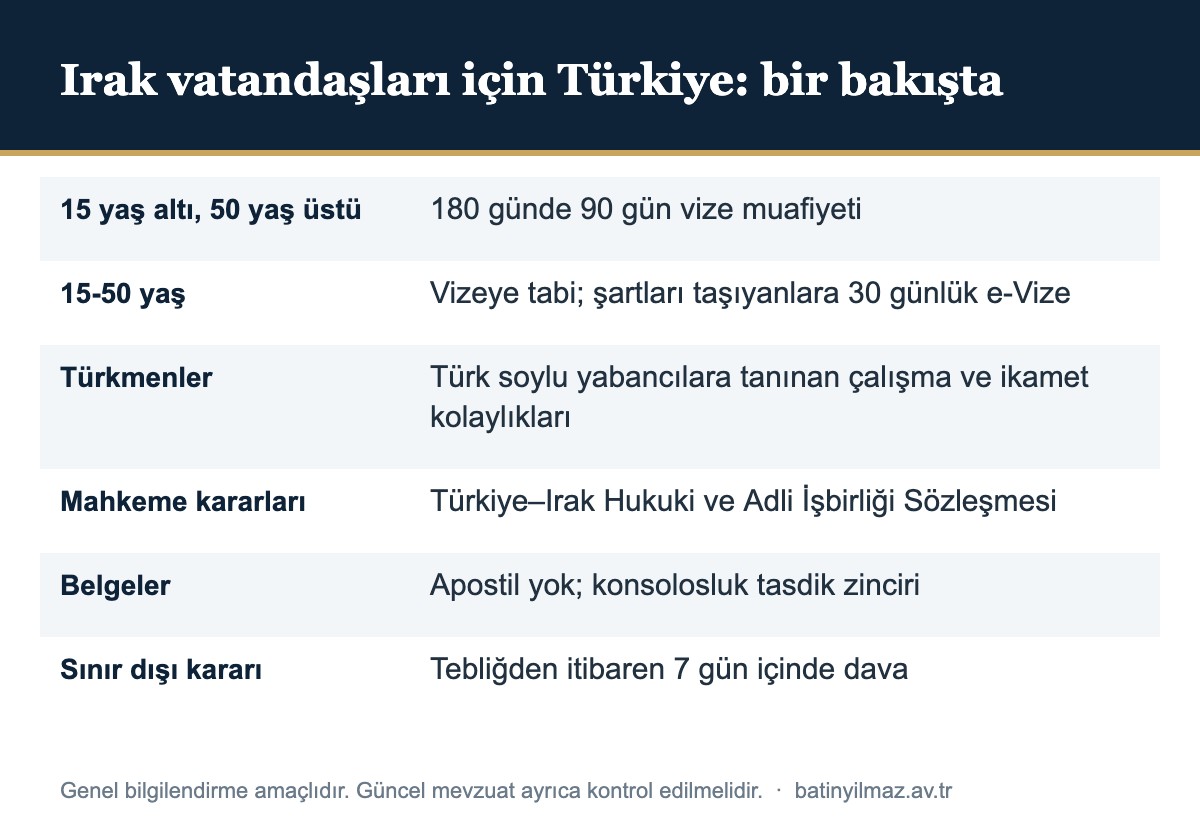
At a glance: subject, rule, legal basis
Scroll sideways for the entire table
| Subject | Rule for Iraqi citizens | Legal Basis |
|---|---|---|
| Entry: under 15 and over 50 | Visa exemption for 90 days in every 180 days with an ordinary passport | Ministry of Foreign Affairs visa regime |
| Entry: 15-50 years old | Subject to visa. If they have a Schengen, US, UK or Ireland visa or residence permit, a 30-day single-entry e-Visa provided that the conditions are met | Ministry of Foreign Affairs visa regime |
| Official passport | Visa exemption for 90 days in every 180 days | Ministry of Foreign Affairs visa regime |
| Residence permit | Short-term permit max 2 years; USD 200,000 threshold for residence through residential property | Article 31 of Law No. 6458; e-Ikamet document list |
| Foreigners of Turkish descent | Free practice of their profession and art; special conditions for long-term residence | Law No. 2527; Law No. 6458 Art. 42/1 |
| Court decisions | Agreement covering judicial assistance, extradition, transfer of sentenced persons and recognition and enforcement of decisions between the two countries | Turkiye–Iraq Agreement on Legal and Judicial Cooperation, OG 02.08.1992/21303 |
| Protection | Conditional refugee or subsidiary protection due to arriving from outside Europe; general security situation is not considered sufficient on its own | Law No. 6458, Art. 62, Art. 63; Constitutional Court of Turkiye (AYM) case law |
| Deportation | Administrative court within 7 days from the date of service | Article 53/3 of Law No. 6458 |
| Documents | Apostille is not valid; a consular chain of certification is required | Iraq is not a party to the Apostille Convention |
Iraqi citizens in Turkiye by the numbers
Scroll sideways for the entire table
| Indicator | Number | Source |
|---|---|---|
| Short-term residence permit (3rd rank among nationalities) | 38.590 | Presidency of Migration Management, 27 August 2026 |
| Student residence permit (8th rank) | 5.601 | Presidency of Migration Management, 27 August 2026 |
| International protection application in 2025 (2nd rank) | 1.463 | Presidency of Migration Management of Turkiye, 2025 |
| Real property sold to Iraqi citizens in October 2026 (3rd rank) | 159 | TUIK Housing Sales Statistics, October 2026 |
| Share among foreigners who left Turkiye in 2025 (1st rank) | %15,7 | TUIK International Migration Statistics, 2025 |
Iraqi citizens rank third in short-term residence permits, third in real property acquisition, and second in international protection applications. They have also become the group of foreigners that left Turkiye the most in 2025. This table shows that a large part of the community remains on short-term permits that are re-evaluated at each extension and that their residence status is fragile.
1. Visa: age-dependent exemption
The Ministry of Foreign Affairs' visa regime divides Iraqi citizens into three groups:
Scroll sideways for the entire table
| Group | Rule |
|---|---|
| Ordinary passport, under 15 years old | Visa-exempt for 90 days within every 180 days |
| Ordinary passport, 15-50 years old | Subject to visa. Holders of a valid Schengen, US, UK, or Ireland visa or residence permit may obtain a single-entry e-Visa with a duration of stay of up to 30 days, provided that they meet certain conditions |
| Ordinary passport, over 50 years old | Visa-exempt for 90 days within every 180 days |
| Official passport | Visa-exempt for 90 days within every 180 days |
The practical result of this distinction for families is that, within the same family, children and parents over 50 years old enter without a visa, while family members between 15-50 years old must obtain a visa. Travel plans should not be made for the entire family, but separately for each individual. For those entering with an exemption, the total stay within the last 180 days cannot exceed 90 days. It is required that the passport be valid for at least 60 days beyond the end of the visa or exemption period (Law No. 6458, Article 15).
Overstaying the period by more than ten days is a ground for deportation (Article 54/1-e) and may lead to an entry ban (Article 9): visa violation penalty, lifting the entry ban, restriction code.
2. Residence permit: large community living with a short-term permit
An Iraqi citizen who will stay longer than the visa or exemption period must apply through e-Ikamet before the period expires. General conditions are explained in our residence permit guide. are included. Prominent grounds in the applications of Iraqi citizens are as follows:
- Real property. The value of a single real property acquired on or after 16 October 2023 must be at least USD 200,000 at the date of acquisition. For real property acquired earlier, the thresholds in effect at that date are applied: property residence permit.
- Tourism. It is common in initial applications; extension requests are strictly reviewed: tourism residence permit.
- Medical treatment. There is a separate ground for those who will receive medical treatment in Turkiye (Article 31/1-f): short-term residence permit for medical treatment purposes.
- Investment. 3-year permit for an investment of USD 150,000, 5-year permit for an investment of USD 200,000 (Art. 31/1-j): residence permit by investment.
- Education and family. Student residence permit, family residence permit.
Change of address and province
Address is the most frequent source of problems for families living with a short-term permit. Change of address must be notified within twenty business days, and one must actually reside at the declared address. Guides: residence permit address inspection, change of residence, Change of city in residence permit, if the appointment is not attended. From our files: because address verification was performed incompletely annulment of the cancellation of a residence permit (Istanbul 15th Administrative Court) and annulment of the cancellation based on verification conducted at the wrong address (Istanbul 16th Administrative Court).
Refusal and cancellation decisions may be subject to an action for annulment at the administrative court; the general time limit for filing a lawsuit in administrative judiciary is 60 days from notification. If a foreigner whose extension application is refused does not depart within ten days, a deportation decision may be issued against them (Article 54/1-j): residence permit rejection, cancellation of residence permit.
3. Iraqi Turkmens: rights granted to foreigners of Turkish descent
Among Iraqi citizens, Turkmens may benefit from a separate regulation as "foreigners of Turkish descent" in Turkish law. This status does not arise automatically; the lineage must be documented.
- Employment. Law No. 2527 on the Free Exercise of Professions and Arts by Foreigners of Turkish Descent and Their Employment in Public and Private Institutions or Workplaces in Turkiye allows foreigners of Turkish descent residing in Turkiye to practice professions and arts that are reserved exclusively for Turkish citizens by law. A work permit is still required; the permit is evaluated within the framework of this Law.
- Long-term residence. In addition to the condition of eight years of uninterrupted residence, the Law stipulates that a long-term residence permit may also be granted to foreigners who meet the conditions determined by the Ministry (Law No. 6458, Article 42/1). In practice, it is reported that the eight-year requirement is not sought for foreigners of Turkish descent: long-term residence permit.
- Citizenship. Being of Turkish descent does not, in itself, confer a right to citizenship; the conditions for application through general, exceptional, or marriage pathways must additionally be met.
It is reported that the implementing regulation concerning foreigners of Turkish descent was amended in 2025. The current regulation regarding the type of documents evidencing descent and the competent application authority must be verified before applying.
Turkmen origin is not sufficient on its own in protection files
In deportation files involving Iraqi Turkmen, the Constitutional Court has adopted the following criterion based on international reports: ethnic origin alone does not prove the risk of ill-treatment; personal elements accompanying that origin (such as the region of origin, being perceived as linked to an organization) must be demonstrated. The Court also states that the general security situation in Iraq does not, of itself, create a real risk for everyone who is returned.
4. Deportation decisions based on intelligence information
A common situation in files involving Iraqi citizens is the issuance of a deportation decision based on intelligence assessment, without the existence of a concrete criminal investigation, on the grounds of connection to a terrorist organization (Art. 54/1-b) or public security (Art. 54/1-d). The current approach of the Constitutional Court is decisive in these files.
Constitutional Court · A.A.S.S. · App. No: 2021/2075 · 04.11.2025
An Iraqi Turkmen living in Turkiye with a short-term residence permit was apprehended one day after the extension of their permit based on intelligence that they were a member of a terrorist organization, and a deportation decision was issued against them. The reasoning of the decision contained only the articles of the law; the facts upon which the assessment was based were not notified to the applicant, and the administrative court accepted the administration's determination without going into detail. The Constitutional Court reached two separate conclusions: as Turkmen origin and general conditions were not sufficient to indicate a real risk, the right to life and the prohibition of ill-treatment were not violated; however, because the applicant was deprived of the opportunity to learn the facts upon which the deportation decision was based and to make an effective defense against them, the right to an effective remedy in connection with the freedom of settlement was violated. The Court ruled that the applicant should not be deported until the proceedings are concluded.
Practical conclusions from the decision:
- A foreigner residing legally in Turkiye benefits from procedural guarantees in deportation proceedings. It is not sufficient for the administration to say 'dangerous in terms of national security'; sufficient and serious information must be presented to the judicial authority.
- In the statement of claim, it should be asserted not only that there is a risk in the country but also that the facts underlying the decision were not notified and that no opportunity for defense was provided.
- Documents showing that you are not subject to any investigation or prosecution must be submitted to the file.
The period for filing a lawsuit is 7 days from service, and the court's decision is final (Art. 53/3). Process: deportation decision, you may refer to our guide on removal centers and objecting to deportation decisions., individual application against a deportation decision. Our files demonstrating that administrative courts look for concrete evidence: annulment of the deportation decision based on public order grounds (Istanbul 1st Administrative Court), Cancellation of the G-87 restriction code and Cancellation of the Ç-149 restriction code (Ankara 26th Administrative Court).
5. International protection
Iraqi citizens became the second nationality to make the most international protection applications in Turkiye in 2025. As they come from outside Europe, those who demonstrate a well-founded fear of persecution can obtain conditional refugee status (Art. 62), and those who will face a serious threat stemming from the death penalty, torture, or armed conflict can obtain subsidiary protection status (Art. 63). Due to the Constitutional Court's case law regarding Iraq, it is decisive that personal elements be presented in detail and with documentation in the application. The application is made in person to the governorate; an administrative objection within 10 days or a lawsuit within 30 days is available against a negative decision (Art. 80): international protection application, right to work for foreigners under international protection, humanitarian residence permit.
6. Real property and Turkish citizenship
Iraqi citizens can acquire residential properties, commercial premises, and land in Turkiye; pursuant to Article 35 of the Land Registry Law (Tapu Kanunu), a limit of 30 hectares per person and 10 percent of the district's surface area, as well as military and security zone restrictions, are applied. Before the purchase, it must be planned that the price be paid through a bank channel and its source be documented: opening a bank account for foreigners, VAT exemption in residential property sales, is the deposit refundable, title deed fee refund.
For citizenship by investment, it is required to acquire real property valued at at least USD 400,000 with an annotation prohibiting its sale for three years, or to make one of the other investments in the amount of at least USD 500,000 (Law No. 5901 Art. 12/1-b): citizenship by investment, certificate of conformity, three-year non-sale annotation. Against the risk of subsequent annulment of citizenship: annulment and withdrawal of the decision granting citizenship. The approach of Iraqi law to multiple citizenship must be confirmed with an Iraqi diplomatic mission before application.
7. Turkiye–Iraq Agreement on Legal and Judicial Cooperation
The treaty between the two countries (Official Gazette 02.08.1992/21303) governs judicial assistance in legal, commercial and criminal matters, extradition of offenders, transfer of convicted persons, and the recognition and enforcement of judicial decisions in a single text. With the entry into force of this treaty, the 1946 extradition and judicial assistance treaties were repealed. It has three consequences for Iraqi citizens:
- Access to courts. Citizens of one party may apply to the courts in the other party's country under the same conditions as that state's own citizens and shall enjoy legal protection.
- Recognition and enforcement of decisions. A recognition or enforcement decision is required for decisions by Iraqi courts regarding divorce, custody, maintenance and receivables to have legal effect in Turkiye; the treaty constitutes the basis for these requests. Our relevant reviews: enforcement of a foreign judgment, recognition of a foreign divorce decree, foreign court jurisdiction clause.
- Extradition and transfer of convicted persons. Extradition requests are reviewed by the heavy penal court; extradition is not accepted for acts that qualify as political crimes (Law No. 6706, Article 11): Yargitay decision regarding an extradition request, transfer of a convicted foreigner.
Regarding tax: the Agreement on the Avoidance of Double Taxation signed between the two countries on 17 December 2020 has been ratified in Turkiye (Law No. 7390; Official Gazette 27.04.2022/31822). According to information from the Ministry of Trade dated 2026, the completion of the ratification process in Iraq is awaited for the agreement to enter into force.
8. Certification of Iraqi documents
Iraq is not a party to the Apostille Convention. The following procedure is followed for documents issued in Iraq such as birth, marriage and divorce certificates, diplomas, criminal records and powers of attorney:
- The document is obtained from the competent authority in Iraq.
- The Iraqi Ministry of Foreign Affairs certifies the document.
- The Turkish mission in Iraq legalizes the certification.
- A sworn translator in Turkiye translates the document into Turkish and it is notarized.
Since the accepted chain of certification for documents issued by the Iraqi Kurdistan Region authorities may vary depending on the institution requesting the document, confirmation should be obtained before beginning the process. General rules: documents issued abroad and apostille, foreign document without an apostille.
9. 6 most common mistakes made by Iraqi citizens
- Assuming that all family members can enter visa-free. The exemption applies only to those under 15 and over 50 years of age.
- Viewing a short-term residence permit as a permanent status and leaving the extension application until the final week.
- Failing to report a change of address or not actually residing at the declared address.
- Expecting to benefit from rights granted to foreigners of Turkish descent without documenting Turkmen origin.
- Relying solely on the general security situation in Iraq in a deportation lawsuit.
- Attempting to perform legal transactions in Turkiye without having a divorce or custody decision obtained from an Iraqi court recognized.
10. Frequently asked questions
Can Iraqi citizens enter Turkiye visa-free?
Holders of ordinary passports under 15 and over 50 years of age are exempt from visas for 90 days within any 180-day period. Those aged 15-50 are subject to a visa.
Can an Iraqi citizen between the ages of 15-50 obtain an e-Visa?
If they have a valid Schengen, US, UK or Ireland visa or residence permit, and meet other requirements, they may obtain a single-entry e-Visa valid for 30 days. Otherwise, a consular visa is required.
Can Iraqis obtain a residence permit in Turkiye by purchasing a home?
Yes. It is required that the value of the single residential property acquired on or after 16 October 2023 be at least USD 200,000 at the date of acquisition.
Can Iraqi Turkmens work without a work permit?
No. Foreigners of Turkish descent must also obtain a work permit; however, the permit is evaluated within the framework of Law No. 2527, and this Law also provides the opportunity to practice professions restricted only to Turkish citizens.
Can a deportation decision based on intelligence information be annulled?
The administration is required to present sufficient and concrete information to the court that the person poses a danger in terms of national security. In its 2025 A.A.S.S. decision, the Constitutional Court ruled that the right to an effective application was violated because the facts on which the decision was based were not disclosed.
Is an Iraqi court's divorce decision valid in Turkiye?
A recognition decision is required for it to produce legal effects in Turkiye. The Legal and Judicial Cooperation Agreement between the two countries regulates the recognition and enforcement of judicial decisions.
Can an apostille be obtained for documents from Iraq?
No. Documents must be certified by the Iraqi Ministry of Foreign Affairs and the Turkish representative office in Iraq.
Sources
- Ministry of Foreign Affairs of the Republic of Turkiye, Visa Regime Applicable to Foreigners
- Law on Foreigners and International Protection No. 6458 (Arts. 9, 15, 31, 42, 53, 54, 62, 63, 80)
- Law No. 2527 on the Freedom of Turkish-Origin Foreigners to Practice Their Professions and Arts in Turkiye
- Agreement on Legal and Judicial Cooperation Between the Republic of Turkiye and the Republic of Iraq, Official Gazette dated 02.08.1992/21303
- Law No. 7390 and Presidential Decree No. 5534 (Agreement for the Avoidance of Double Taxation Between Turkiye and Iraq), Official Gazette dated 27.04.2022/31822
- Turkish Citizenship Law No. 5901, Art. 12; Land Registry Law No. 2644, Art. 35; Law No. 6706, Art. 11
- Presidential Decree No. 11994, Official Gazette 18.11.2026/33434
- Presidency of Migration Management statistics (27 August 2026; 2025 international protection); TurkStat House Sales Statistics, October 2026; TurkStat International Migration Statistics, 2025
- Anayasa Mahkemesi, A.A.S.S., App. No: 2021/2075, 04.11.2025; N.S.M.M., App. No: 2020/18122, 17.07.2024
Conclusion
For Iraqi citizens, the decisive factors in legal proceedings in Turkiye are: the variation of visa rules based on age, the reassessment of short-term residence permits at each extension, the documentation of lineage for Turkmens, and the invocation of both personal status and procedural guarantees in deportation cases. Since legislation and administrative practices change frequently, each specific case must be evaluated individually according to current rules.
Author Information
Attorney Batın YILMAZ
Istanbul Bar Association Bar Registry No: 77008
Compliance Statement with TBB Professional Rules and Advertising Prohibition
This content is for informational purposes only. It does not aim to advertise, secure business, acquire clients, solicit, claim professional superiority, or guarantee results for any person or institution.
While preparing the content the Professional Rules of the Union of Turkish Bar Associations and the provisions regarding the prohibition of advertising for the legal profession have been observed. The information in this article does not constitute legal counsel or a definitive legal opinion with respect to any specific case.
Communication and Legal Information
Attorney Batın YILMAZ
Istanbul Bar Association Bar Registry No: 77008
This contact section has been prepared solely for the purpose of indicating communication channels regarding legal services and does not carry the purpose of advertising, solicitation, acquiring clients, or claiming professional superiority .
Phone : 0 532 669 34 90
Author
Atty. Batın Yılmaz
Founding attorney of Batın Yılmaz Law Office. Handles litigation and consultancy in foreigners and citizenship law, as well as criminal, corporate, administrative, real estate, enforcement, and compensation law.
About our office